|
KOSHER DELIGHT - YOUR JEWISH ONLINE MAGAZINE!
|
|
|
 |
|
|
|
|
|
|
| |
JUDAISM 101 |
|
| |
THE MIKVAH:

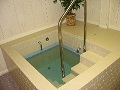
Pool of a
medieval mikveh in
Speyer, dating back to 1128
--- What is Mikvah?
Mikveh (often
mistaken as
mikvah, or
either way without the ending -"h") (Hebrew:
מִקְוֶה / מקווה,
Modern Miqve
Tiberian Miqwāh;
plural:
mikva'ot or
mikves
Hebrew:
מִקְוֶוֹת / מִקְוָאות) is a bath used for the
purpose of
ritual immersion in Judaism. The word "mikveh", as
used in the
Hebrew Bible, literally means a "collection" –
generally, a collection of water.
Several biblical regulations specify
that full immersion in water is required to regain
ritual purity after ritually impure incidents have
occurred. Most forms of impurity can be nullified
through
immersion in any natural collection of water. Some,
such as a
Zav, however require "living water,"such as springs
or groundwater wells. Living water has the further
advantage of being able to purify even while flowing as
opposed to rainwater which must be stationary in order
to purify. The mikveh is designed to simplify
this requirement, by providing a bathing facility that
remains in ritual contact with a natural source of
water.
Its main uses nowadays are:
In
Orthodox Judaism these regulations are steadfastly
adhered to, and consequently the mikveh is central to an
Orthodox Jewish community, and they formally hold in
Conservative Judaism as well. The existence of a
mikveh is considered so important in Orthodox Judaism,
that an Orthodox community is required to construct a
mikveh before building a
synagogue, and must go to the extreme of selling
Torah scrolls or even a synagogue if necessary, to
provide funding for the construction.
Reform Judaism and
Reconstructionist Judaism regard the biblical
regulations as
anachronistic to some degree, and consequently do
not put much importance on the existence of a mikveh.
Some opinions within
Conservative Judaism have sought to retain the
ritual requirements of a mikveh while recharacterizing
the theological basis of the ritual in concepts other
than
ritual purity.
Ancient mikvehs dating from before
the late first century can be found throughout the land
of
Israel as well as in historic communities of the
Jewish diaspora. In modern times, mikvehs can be
found in most communities in Orthodox Judaism. Jewish
funeral homes may have a mikveh for immersing a body
during the purification procedure (tahara)
before burial.
Requirements of a mikveh
The traditional rules
regarding the construction of a mikveh are based
on those specified in
classical rabbinical literature. According
to these rules, a mikveh must be connected to a
natural spring or well of naturally occurring
water, and thus can be supplied by rivers and
lakes which have natural springs as their
source. A
cistern filled by the rain is also permitted
to act as a mikveh's water supply. Similarly
snow, ice and hail are allowed to act as the
supply of water to a mikveh, as long as it melts
in a certain manner.A river that dries up on a
regular basis cannot be used because it is
presumed to be mainly rainwater, which cannot
purify while flowing. Oceans for the most part
have the status of natural springs.
A mikveh must, according to
the classical regulations, contain enough water
to cover the entire body of an average-sized
person; based on a mikveh with the dimensions of
3
cubits long, 1 cubit wide, and 1 cubit deep,
the necessary volume of water was estimated
as being 40
seah of water. The exact volume referred
to by a seah is debated, and classical
rabbinical literature only specifies that it is
enough to fit 144 eggs; most Orthodox Jews use
the stringent ruling of the
Avrohom Yeshaya Karelitz, according to which
one seah is 14.3 litres, and therefore a
mikveh must contain approximately 575
litres.
This volume of water could be topped
up with water from any source,
but if there were less than 40
seahs of water in the mikveh, then the addition
of 3 or more
pints of water from an unnatural source
would render the mikveh unfit for use,
regardless of whether water from a natural
source was then added to make up 40 seahs from a
natural source; a mikveh rendered unfit for use
in this way would need to be completely drained
away and refilled from scratch.
There are also classical
requirements for the manner in which the water
can be stored and transported to the pool; the
water must flow naturally to the mikveh from the
source, which essentially means that it must be
supplied by gravity or a natural pressure
gradient, and the water cannot be pumped there
by hand or carried. It was also forbidden for
the water to pass through any vessel which could
hold water within it, (however pipes open to the
air at both ends are fine)
as a result,
tap water could not be used as the primary
water source for a mikveh, although it can be
used to top the water up to a suitable level. To
avoid issues with these rules in large cities,
various methods are employed to establish a
valid mikveh. One is that tap water is made to
flow over the top of a kosher mikveh, and
through a conduit into a larger pool. A second
method is to create a mikveh in deep pool, place
a floor with holes over that and then fill the
upper pool with tap water. Like this the person
dipping is actually "in" the pool of rain water.
Most contemporary mikvehs are
indoor constructions, involving rain water
collected from a cistern, and passed through a
duct by gravity into an ordinary bathing pool;
the mikveh can be heated, taking into account
certain rules, often resulting in an environment
not unlike a
spa.
Reasons for immersion in a
Mikveh
Historic reasons

First
room in the medieval mikveh in Speyer>
Traditionally, the mikveh was
used by both men and women to regain ritual purity
after various events, according to regulations laid
down in the Torah and in classical rabbinical
literature. The Torah requires full immersion
- after
Keri —
normal emissions of semen, whether from
sexual activity, or from
nocturnal emission; bathing in a mikveh
due to Keri is known as tevilath Ezra
(“the immersion of
Ezra”)
- after
Zav/Zavah — abnormal discharges of bodily
fluids
- after
Tzaraath
— certain skin condition(s). These
are termed lepra in the
Septuagint, and therefore traditionally
translated into English as
leprosy; this is probably a translation
error, as the Greek term lepra mostly
refers to
psoriasis, and the Greek term for leprosy
was elephas/elephantiasis.
- by anyone who came into
contact with someone suffering from Zav/Zavah,
or into contact with someone still in
Niddah (normal
menstruation), or who comes into contact
with articles that have been used or sat upon by
such persons.
- by
Jewish priests when they are being
consecrated
- by the
Jewish high priest on
Yom Kippur, after sending away the goat to
Azazel, and by the man who leads away the
goat
- by the Jewish priest who
performed the
Red Heifer ritual
- after contact with a
corpse or
grave, in addition to having the ashes of
the Red Heifer ritual sprinkled upon them
- after eating
meat from an
animal that died naturally
Classical rabbinical writers conflated the
rules for zavah and niddah. It also became customary for priests
to fully immerse themselves before
Jewish holidays, and the
laity
of many communities subsequently adopted this practice. Converts
to Judaism are required to undergo full immersion in water.
R' Aryeh Kaplan in Waters of Life connects
the laws of impurity to the narrative in the beginning of
Genesis. According to Genesis, By eating of the fruit Adam
and Eve had brought death into the world. Kaplan points out that
most of the laws of impurity relate to some form of death (or in
the case of Niddah the loss of a potential life). One who comes
into contact with one of the forms of death must then immerse in
water which is described in Genesis as flowing out of the Garden
of Eden (the source of life) in order to cleanse oneself of this
contact with death (and by extension of sin).
Orthodox
Judaism
Orthodox Judaism generally adheres to the
classical regulations and traditions, and consequently Orthodox
Jewish women are obligated to immerse in a mikveh between
Niddah and sexual relations with their husbands. This
includes brides before their
marriage, and married women after their menstruation period
or childbirth. In accordance with
Orthodox rules concerning modesty, men and women are
required to immerse in separate mikveh facilities in separate
locations, or to use the mikveh at different designated times.
Converts to Orthodox Judaism, regardless of gender, are also
required to immerse in a mikveh. It is customary for Orthodox
Jews to immerse before Yom Kippur,
and married women sometimes do so as well. In
the
customs of certain Jewish communities, men also use a mikveh
before Jewish holidays;
the men in certain communities, especially
hasidic and
haredi groups, also practice immersion before each
Shabbat, and some immerse in a mikveh every single day.
Although the
Temple Mount is treated by many Orthodox Jewish authorities
as being forbidden territory, a small number of groups permit
access, but require immersion before ascending the Mount as a
precaution.
Orthodox Judaism requires that vessels and
utensils must be immersed in a mikveh before being used for
food, if they had been purchased from a non-Jew.
Obligatory immersion in Orthodox Judaism
Immersion in a mikveh is obligatory in
contemporary
Orthodox Jewish practice in the following circumstances:
- Women
- Following the
niddah period after menstruation, prior to
resuming
marital relations
- Following the
niddah period after childbirth, prior to
resuming marital relations
- By a bride, before her wedding
- Either gender.
- Immersion of utensils acquired from a
gentile
Customary immersion in Orthodox Judaism
Immersion in a mikveh is customary in
contemporary
Orthodox Jewish practice in the following circumstances:
- Men
- By a bridegroom, on the day of
his wedding, according to the custom of some communities
- By a father, prior to the
circumcision of his son, according to the custom of
some communities[which?].
- By a
kohen prior to a service in which he will recite the
priestly blessing, according to the custom of some
communities
- Before Yom Kippur, according to
the custom of some communities
- Before a
Jewish holiday, according to the
custom of some communities
- Weekly before
Shabbat, under
Hasidic and
Haredi customs
- Every day, under
Hasidic
customs
Immersion for men is more common in
Hasidic communities, and non-existent in others, like
Yekke communities.
Conservative Judaism
In a series of responsa on the subject of
Niddah in December 2006, the
Committee on Jewish Law and Standards of
Conservative Judaism reaffirmed a requirement that
Conservative women use a mikveh monthly following the end of the
niddah period following
menstruation, while adapting certain leniencies including
reducing the length of the period. The three responsa adapted
permit a range of approaches from an opinion reaffirming the
traditional ritual to an opinion declaring the concept of ritual
purity does not apply outside the
Temple in Jerusalem, proposing a new theological basis for
the ritual, adapting new terminology including renaming the
observances related to menstruation from taharat hamishpacha
family purity to kedushat hamishpaha [family
holiness] to reflect the view that the concept of
ritual purity is no longer considered applicable, and
adopting certain leniencies including reducing the length of the
niddah period.
Isaac Klein's A Guide to Jewish Religious Practice, a
comprehensive guide frequently used within Conservative Judaism
also addresses Conservative views on other uses of a mikveh, but
because it predates the 2006 opinions it describes an approach
more closely resembling the Orthodox one and does not address
the leniencies and views those opinions reflected. Rabbi
Miriam Berkowitz's recent book Taking the Plunge: A
Practical and Spiritual Guide to the Mikveh (Jerusalem:
Schechter Institute, 2007) offers a comprehensive discussion of
contemporary issues and new mikveh uses along with traditional
reasons for observance, details of how to prepare and what to
expect, and how the laws developed. Conservative Judaism
encourages but does not require immersion before Jewish Holidays
(including Yom Kippur), nor the immersion of utensils purchased
from non-Jews. New uses are being developed throughout the
liberal world for healing (after rape, incest, divorce etc.) or
celebration (milestone birthdays, anniversaries, ordination, or
reading Torah for the first time).
Although monthly immersion is formally
required of Conservative Jewish women, the practice is not
widely adhered to within the Conservative laity. However more
and more congregations are building their own mikvaot, and
observance is becoming more popular.
Reform and Reconstructionist Judaism
Reform and
Reconstructionist Judaism do not hold the halachic
requirements of mikveh the way orthodox Judaism does. However,
there are growing trends toward using mikveh for conversions,
wedding preparation, and even before holidays. While most Reform
Jews will probably never see the inside of a mikveh, there are
many (particularly converts) who will fulfill the mitzvah at
least once in their lives.
Requirements during use of a mikveh
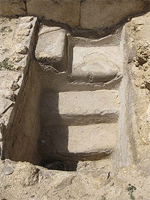
▼Mikveh
in
Herodium, late
Second Temple
period, approximately 69AD
 The
classical requirement for full immersion was traditionally
interpreted as requiring water to literally touch every part of
the body, and for this reason all clothing, jewellery, and even
bandages must be removed; in a contemporary mikveh used by
women, there is usually an experienced attendant, commonly
called the mikveh lady, to watch the immersion and ensure
that the woman has been entirely covered in water. The
classical requirement for full immersion was traditionally
interpreted as requiring water to literally touch every part of
the body, and for this reason all clothing, jewellery, and even
bandages must be removed; in a contemporary mikveh used by
women, there is usually an experienced attendant, commonly
called the mikveh lady, to watch the immersion and ensure
that the woman has been entirely covered in water.
According to rabbinical tradition, the
hair counts as part of the body, and therefore water is required
to touch all parts of it, thus meaning that braids cannot be
worn during immersion; this has resulted in debate between the
different
ethnic groups within Judaism, about whether hair combing is
necessary before immersion. The
Ashkenazi community generally supports the view that hair
must be combed straight so that there are no knots, but some
Black Jews take issue with this stance, particularly when it
comes to
dreadlocks. A number of rabbinical rulings
argue in support of dreadlocks, on the basis that
- dreadlocks can sometimes be loose
enough to become thoroughly saturated with water,
particularly if the person had first showered
- combing dreadlocked hair can be
painful
- although a particularly cautious
individual would consider a single knotted hair as an
obstruction, in most cases hair is loose enough for water to
pass through it, unless each hair is individually knotted
Allegorical uses of the term Mikveh
The word mikveh makes use of the
same root letters in Hebrew as the word for "hope" and this has
served as the basis for homiletical comparison of the two
concepts in both biblical and rabbinic literature. For instance,
in the
Book of Jeremiah, the word mikveh is used in the
sense of "hope," but at the same time also associated with
"living water":
- O Hashem, the Hope [mikveh] of
Israel, all who forsake you will be ashamed ... because they
have forsaken Hashem, the fountain of living water
- Are there any of the worthless
idols of the nations, that can cause rain? or can the
heavens give showers? Is it not you, Hashem our God, and do
we not hope [nekaveh] in you? For you have made all these
things.
In the
Mishnah, following on from a discussion about Yom Kippur,
immersion in a Mikveh is compared by
Rabbi Akiva with the relationship between God and Israel.
Akiva refers to the description of God in the Book of Jeremiah
as the Mikveh of Israel, and suggests that just as a
mikveh purifies the contaminated, so does the Holy One, blessed
is he, purify Israel.
A different allegory is used by many Jews
adhering to a belief in
resurrection as one of the
Thirteen Principles of Faith. Since "living water" in a
lifeless frozen state (as
ice)
is still likely to again become living water (after
melting), it became customary in traditional
Jewish bereavement rituals to read the seventh chapter of
the
Mikvaot tractate in the Mishnah, following a funeral; the
Mikvaot tractate covers the laws of the mikveh, and the seventh
chapter starts with a discussion of substances which can be used
as valid water sources for a mikveh - snow, hail, frost, ice,
salt, and pourable
mud.
Source:
http://en.wikipedia.org/wiki/Mikveh
|
|
| |
|
|
|
KOSHER DELIGHT MAGAZINE
|